

Warnings of a supposedly dangerous sweet called Astrosnacks have caused widespread concern across London, despite authorities failing to verify the claims.
The messages were sent out by schools and councils, and later shared widely on social media. Islington Now has seen a copy of the warning that was first circulated to parents of pupils at a school in Archway in late February.
Text warned of fake snack alleged to make children sick
A text alert (pictured below), seen by the parents of over 300 children, read: “We have received information from the Met police to say that a fake snack bar called ‘Astrosnacks’ is being sold to children in the Highgate area which makes them violently sick and have hallucinations. Please warn your child not to purchase/eat it if offered.”
Information was also posted on the school’s website but was removed several days later. A spokesperson for Highgate Hill said: “we have had no reports of any products like this at the school.”
Parents expressed their confusion and concern.
Twitter user LadyChappers approached LTS and the Met on social media, writing: “Hi @London_T_S and @metropoliceuk. I have received a vague email claiming you’re warning parents in Islington that children are being sold a hallucinogenic and vomit-inducing sweet called ‘Astrosnacks’. Given no updates on your website, I assume this is fake? Pls advise.”
Parents left confused and worried
Another user, Pete, tweeted: “I wonder if ‘Astrosnacks’ will be the next moral panic after Momo? I’ve seen vaguely-worded forwarded-by-a-friend-of-a-friend messages claiming ‘London Trading Standards’ & the Met are warning these are being sold to children & ‘cause severe hallucinations.’”
Axel, who also received an email warning, added: “This latest hoax demonstrates once more how difficult it is for parents and children, but also schools to scrutinise online content and distinguish the genuine from the fake.”
People need ” clear, unambiguous and proportional information”
Speaking to Islington Now, Tom Phillips, Editor at Fullfact, a UK-based independent fact-checking organisation, said: “This shows the importance of people getting clear, unambiguous and proportional information from public bodies. Parents understandably worry about risks to their children — but it’s very easy for both real risks and false alarms to get taken out of context and amplified on social media.”
The snack is believed to have been first flagged up by members of a private Whatsapp group before being brought to the attention of the Met Police.
After turning down Islington Now’s request to see the original message, the Met said in a statement that “no crime report has been made and the allegation has not been substantiated. Police have not been able to speak directly to the parties who were apparently affected.”
“As a matter of routine, and to safeguard young people, police have passed this information to schools local to the incident.”
Risk to children minimal – Met police
A report from Telegraph yesterday revealed that a police source suggested the snack may have contained cannabis resin, but the risk to children was minimal.
Islington Now has since discovered an image of a cannabis-infused food shared on Instagram under the hashtag #LondonEdibles with the exact same branding. Beneath the ‘astrosnacks’ logo was a warning that the bar contains “150mg THC, 2 servings per pack.”
The ‘Astrosnacks’ scare turned into a London-wide issue after posts made on a public Facebook group, containing over 2,000 members, were followed up by the Evening Standard. A reporter from the paper reached out to Public Health England (PHE) for information.

PHE then referred the enquiry on to London Trading Standards (LTS), which asked all 33 local authority services across the capital whether they had been made aware of any similar cases.
Islington Now spoke to a representative of Southwark council, who confirmed they had distributed the email from LTS to each of the 150 schools within their remit.
School head warned of spread of hoax
The Telegraph also obtained a letter from St Alban’s primary and nursery school in Holborn, in the borough of Camden, which was sent out on 12 March. The interim head of the school, Rebecca Harris, wrote to parents warning that the “focus could be shifting to the Camden area.”
Islington council refused to give Islington Now a comment about the issue.
LTS operations director, Stephen Knight, said: “We have not issued any warning to schools or parents about these snack bars. I understand that in one borough, our email (meant for internal trading standards information) has erroneously been circulated to schools, which was never our intention.”
Another ‘hoax’ fuelled by media?
Google search trends show that hits for the term “Astrosnacks” spiked on 28 February, when the warning was sent out from Highgate Hill Academy, and then again on 6 March, when the Evening Standard first investigated the matter.
The uncertainty surrounding Astrosnacks comes not long after the Momo hoax, in which schools alerted parents to issues of child safety that were ultimately found to be false.
The fake “suicide game” involved a creepy cartoon character that would “hack” into WhatsApp messages and set children disturbing challenges such as harming themselves.
However the UK Safer Internet Centre discredited the Momo scare. Kate Tremlett, the organisation’s harmful content manager, later labelled it “a myth that is perpetuated into being some kind of reality.”
Highgate Hill Academy also warned parents about the Momo challenge at the time.
Images widely spread on social media
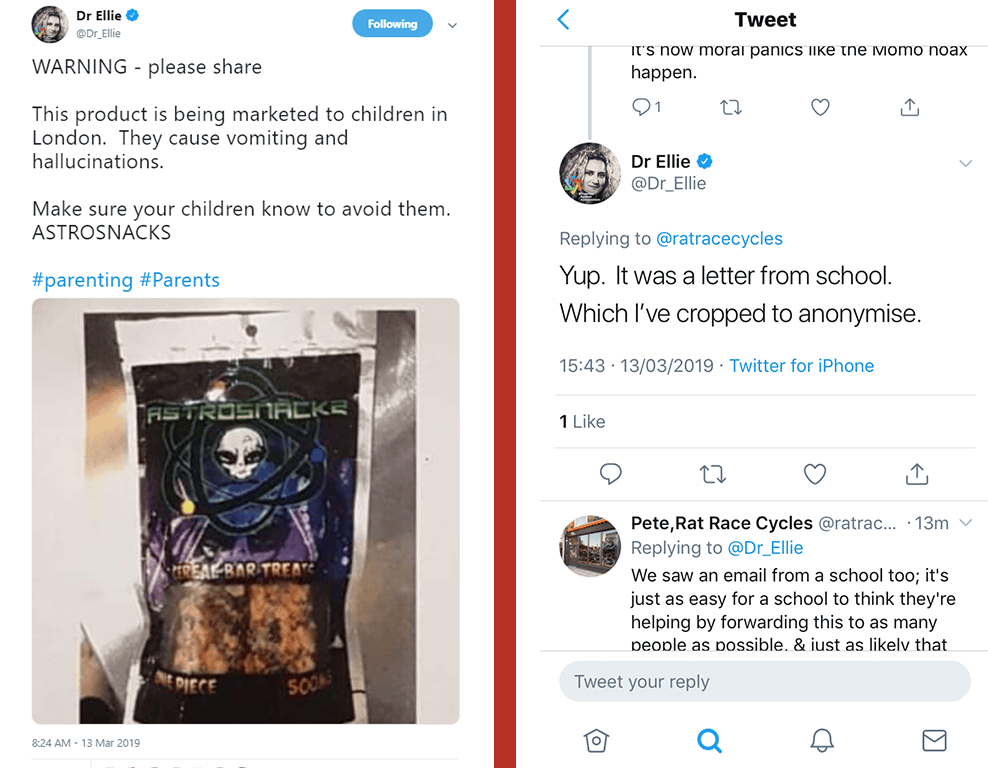
Dr Ellie Cannon, a columnist at the Mail on Sunday, also shared a screenshot of the “Astrosnacks” email she had received from her child’s school with her 22.7 thousand followers on Twitter. The caption read: “WARNING – please share. This product is being marketed to children in London. Make sure your children know to avoid them ASTROSNACKS #parenting #Parents.”
The tweet was deleted after Islington Now approached Dr Cannon’s representatives for comment.
Other recipients of emails warning of Astrosnacks were more sceptical.
Speaking to Islington Now, one parent said: “How are they being sold to children? They’re snacks – children are unlikely to buy snacks from anything other than a corner shop.
“There only seems to be one photo in circulation and the brand doesn’t appear to come up in any search in the 20-30 minutes I spent yesterday having a hunt around.
“The snacks look like the homemade cereal bars which people post images of on Instagram, which definitely look like they might make you sick if you ate lots of them because they’re highly coloured and sugary!”
Additional reporting by Marcus Parekh

