

The latest performance of the dance troop Candoco is most certainly one of the most intriguing shows that I’ve been given to see over the last couple of years.
Watching The Show Must Go On makes you laugh, cry, sing.
You oscillate between tears of joy and emotion, between feeling incredibly light-hearted and being emotionally and intellectually challenged.
One has never felt as close to the artists performing on stage, and this is the very essence of the production.
Presented at Sadler’s Wells’ as part of the =dance series, which feature inclusive dance by both established and emerging deaf and disabled artists, The Show Must Go On was warmly applauded by the public on Saturday.
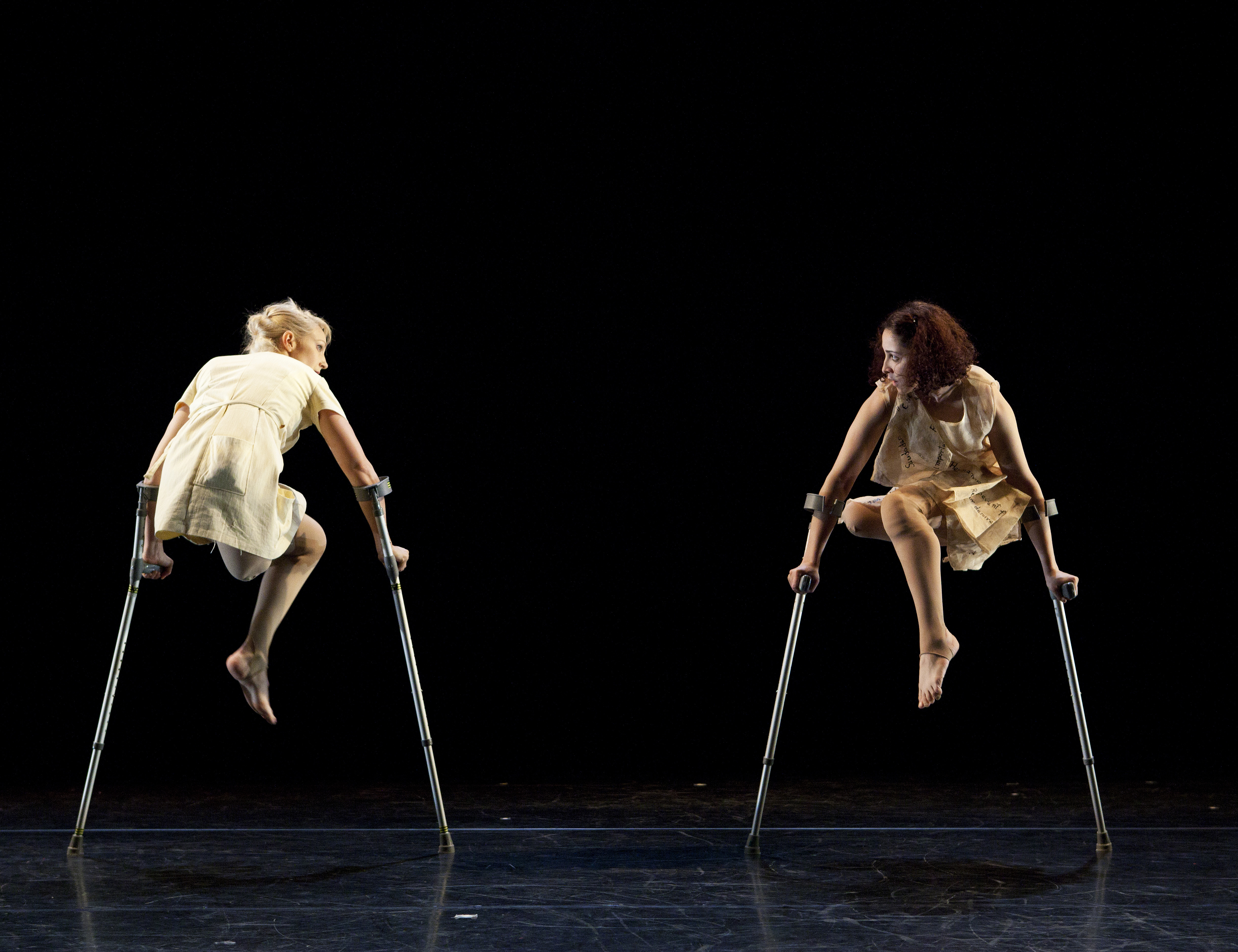
Premiered in 2001 in Paris, the ballet has toured in nearly 30 countries and has been performed for the last 14 years. It is one of the landmark works of French choreographer and director Jérôme Bel, well-known for his controversial productions that challenge traditional art forms.
This version of The Show is the product Candoco’s and Bel’s joint effort. It brings together six dancers from the usual Candoco troop, joined by 15 other performers who were plucked from 300 applicants all over the UK.
Some of them are trained dancers or come from other performance backgrounds, but others are having their very first experience on stage. This is at the very heart of the show’s spirit.
In fact, the aim of the show is to subvert the codes and preconceived ideas about dancing and performance.
It forces the audience to ask itself what a performance really is, and who is entitled to perform it. Is there such a thing as an artist entitled to perform a show to start with?
In Bel’s own words, “the audience should recognise themselves on stage.”

Hence the repeated moments of inaction during the show, where nothing goes on, and the public is almost left on its own.
Whether this process is actually efficient and understood by the audience is of course arguable, and will depend on each person’s reception and interpretation of the performance.
What is for sure is that Candoco does not leave you indifferent.
As all performers stand together in a semi-circle on stage, simply standing still and staring right at you, with Let the Sunshine In from the musical Hair playing in the background, you understand that this is not a one-sided performance: it is a mutual experience between the public and those on stage.
The first song used in the show, Come Together by the Beatles, sets the tone for the rest of the performance: it is about a group of people, disabled and not disabled, performing all together, without differentiating between each other.
In fact, for most of the show, the entire troop is always together on stage, which often produces beautiful visual effects and a colourful staging.
The performers (and here one would really call them performers rather than artists, in accordance with the spirit of the production) look voluntarily natural and unpretentious, wearing everyday casual outfits.
“I could be on that stage,” you think to yourself. This really seems to be the message that the production aims at communicating to the public.
The Show Must Go On is admirable in the sense that it requires from its performers to get rid of any shames and complexes they might have, to expose themselves entirely without any inhibition.

The performers are not afraid to show their flaws, or even use them for the purpose of the performance.
Here one will think of the man playing with his big belly in the first scene, or of the girl climbing up and down her wheelchair.
Henrique Neves, Restaging Assistant, said about the performance: “It’s non-hierarchical, non-judgemental, that’s the whole premise of the work. It obliterates all notion of virtuosity or technique as requirements for performance.”
The Show Must Go On is at once a touching and thought-provoking, inviting the audience to mirror themselves in the performers on stage.
Candoco is a dance company that was founded in 1991, bringing together disabled and non-disabled performers, advocating for inclusive practice and an increased access and diversity in the cultural sector and beyond. It was the first company of its kind in the UK, and has been granted the Liberty Human Rights Award.

